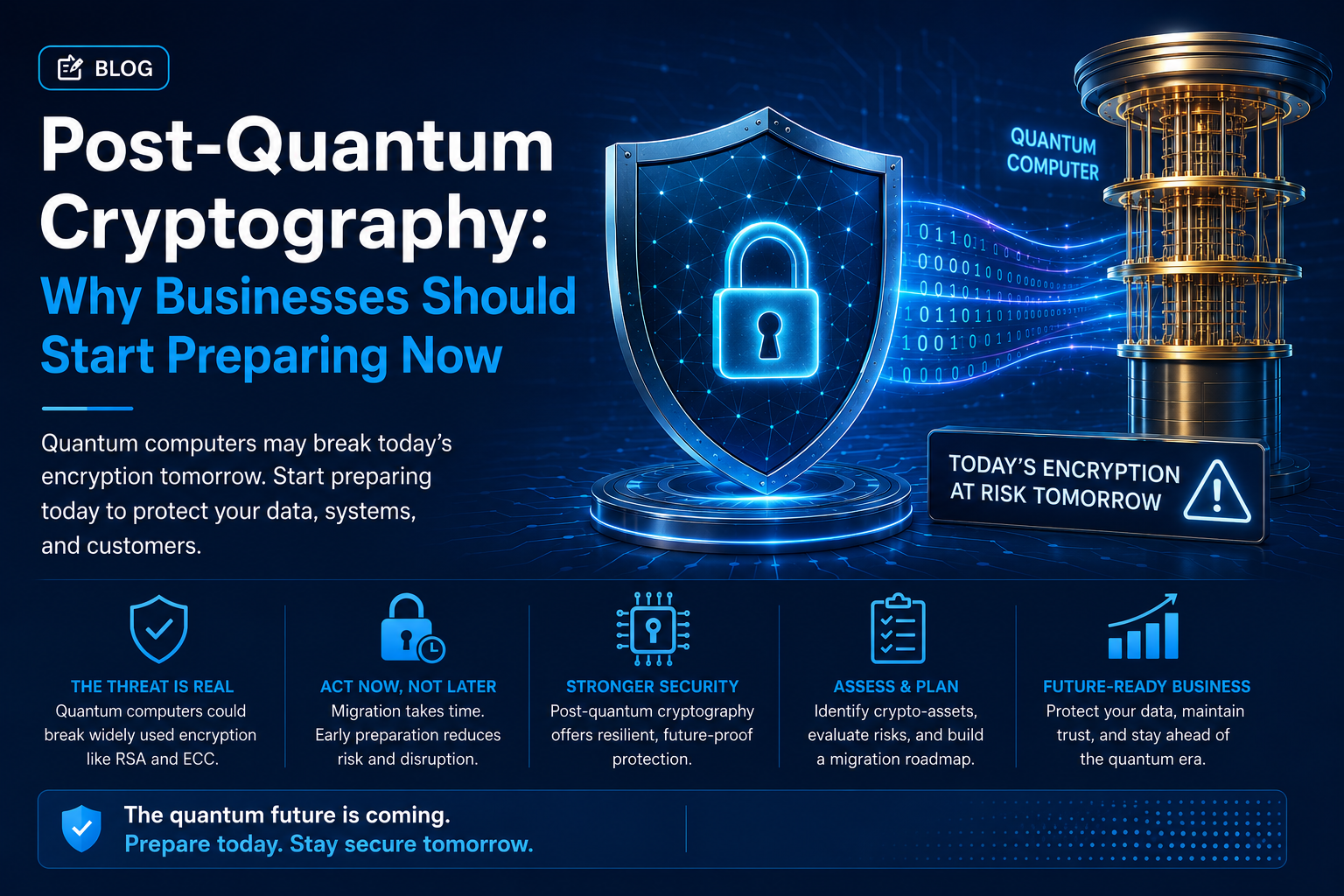
Post-Quantum Cryptography: Why Businesses Should Prepare Now
Post-Quantum Cryptography: Why Businesses Should Start Preparing Now
Quantum computing has the potential to transform industries by solving certain complex computational problems far more efficiently than conventional computers. While large-scale, fault-tolerant quantum computers are still under development, their potential impact on cybersecurity is already influencing how organizations plan for the future.
One of the biggest concerns is that sufficiently powerful quantum computers could break some of the public-key cryptographic algorithms widely used today to protect digital communications, identities, transactions, and sensitive information.
This has accelerated interest in Post-Quantum Cryptography (PQC) — cryptographic methods designed to remain secure against attacks from both conventional and quantum computers.
For businesses, preparing for post-quantum security is not simply about replacing an encryption algorithm. It requires understanding where cryptography is used, identifying vulnerable systems, managing long-lived data, and developing a practical migration strategy.
What Is Post-Quantum Cryptography?
Post-Quantum Cryptography refers to cryptographic algorithms designed to resist attacks from quantum computers while continuing to operate on conventional computing infrastructure.
Today's security infrastructure relies heavily on public-key algorithms such as RSA and elliptic-curve cryptography. Large-scale quantum computers could potentially use Shor's algorithm to solve the mathematical problems underlying these systems much more efficiently than classical computers.
PQC aims to provide alternative cryptographic techniques that can withstand these future capabilities.
Importantly, post-quantum cryptography is different from quantum cryptography. PQC primarily involves mathematical algorithms that run on existing computers, whereas quantum cryptography uses principles of quantum physics for security applications.
Why Should Businesses Care About Quantum Security?
Quantum computing may appear like a distant technology challenge, but cybersecurity planning often needs to happen years before a threat becomes practical.
There are several reasons businesses should begin preparing now.
1. Sensitive Data Has a Long Lifespan
Some information needs to remain confidential for many years.
Examples include:
- Financial records
- Intellectual property
- Research data
- Customer information
- Government-related information
- Healthcare and scientific data
- Business strategies
- Authentication credentials
Attackers may capture encrypted information today and attempt to decrypt it later when sufficiently capable quantum computers become available.
This is commonly referred to as the "harvest now, decrypt later" threat.
2. Cryptographic Migration Takes Time
Encryption is deeply embedded into modern technology environments.
It can exist within:
- Web applications
- APIs
- Databases
- Cloud platforms
- VPNs
- Digital certificates
- Mobile applications
- Identity systems
- Payment systems
- IoT devices
- Internal communication platforms
Replacing cryptographic mechanisms across a large enterprise can therefore take considerable planning and testing.
3. Third-Party Dependencies Matter
Businesses rarely control their entire technology stack.
Applications may rely on:
- Cloud providers
- SaaS platforms
- Payment gateways
- Software libraries
- Hardware vendors
- Security products
- External APIs
Even if an organization modernizes its own systems, outdated cryptographic dependencies elsewhere can create security gaps.
Which Cryptographic Systems Are at Risk?
The potential quantum threat primarily affects widely deployed public-key cryptographic systems.
These include algorithms based on mathematical problems that quantum computers could potentially solve efficiently.
Symmetric encryption and hashing are affected differently. Quantum algorithms can provide speedups against certain brute-force attacks, but the impact is not equivalent to the threat posed to widely used public-key cryptography.
Organizations should therefore evaluate their entire cryptographic environment rather than assuming that every security mechanism will become obsolete at the same time.
The Role of NIST in Post-Quantum Security
The U.S. National Institute of Standards and Technology (NIST) has been working on standardizing post-quantum cryptographic algorithms.
NIST finalized its first principal PQC standards in 2024, including ML-KEM for key establishment and ML-DSA and SLH-DSA for digital signatures.
These standards provide organizations with a foundation for planning future cryptographic migrations.
Businesses should monitor developments from standards organizations and technology providers rather than waiting until quantum computing becomes commercially mature.
A Practical Post-Quantum Cryptography Readiness Roadmap
Organizations do not necessarily need to replace all cryptography immediately. A structured preparation strategy can help reduce future migration risks.
Step 1: Build a Cryptographic Inventory
Start by identifying where cryptography is being used.
Review:
- Applications
- Servers
- Databases
- APIs
- Cloud infrastructure
- Network security systems
- Certificates
- Authentication systems
- Software libraries
- Third-party services
- Connected devices
The objective is to understand the organization's cryptographic footprint.
Step 2: Identify Vulnerable Algorithms
Determine which systems depend on cryptographic algorithms that may be vulnerable to future quantum attacks.
Document:
- Algorithm types
- Key sizes
- Certificate configurations
- Protocol versions
- Cryptographic libraries
- Dependencies
- Data protection mechanisms
This creates visibility into potential migration requirements.
Step 3: Classify Data by Sensitivity and Lifespan
Not all business data has the same security requirements.
Organizations should determine:
- How sensitive the data is
- How long it needs to remain confidential
- Where it is stored
- Who can access it
- How it is transmitted
- Whether it could be targeted for future decryption
Long-lived sensitive information should receive particular attention.
Step 4: Prioritize High-Risk Systems
Businesses should prioritize systems based on risk rather than attempting to modernize everything simultaneously.
High-priority systems may include:
- Financial platforms
- Identity infrastructure
- Critical APIs
- Long-term confidential data
- Intellectual property systems
- Government or regulated workloads
Customer authentication systems
Step 5: Adopt Crypto-Agility
One of the most important concepts in post-quantum readiness is crypto-agility.
Crypto-agility means designing systems so cryptographic algorithms can be changed without rebuilding the entire application or infrastructure.
Organizations can improve crypto-agility through:
- Modular cryptographic implementations
- Centralized key management
- Configurable security policies
- Standardized APIs
- Regular dependency updates
- Automated certificate management
A crypto-agile architecture can make future security transitions significantly easier.
Step 6: Work With Technology Providers
Businesses should ask vendors and technology partners about their post-quantum roadmaps.
Important questions include:
- Does the platform support modern cryptographic standards?
- Is a post-quantum migration roadmap available?
- Can cryptographic algorithms be upgraded without major application changes?
- How are encryption keys managed?
- How frequently are security components updated?
Vendor readiness can become an important factor in technology procurement decisions.
Step 7: Test Before Large-Scale Migration
Before deploying new cryptographic standards across production environments, organizations should conduct controlled testing.
Testing should evaluate:
- Application compatibility
- Performance
- Network overhead
- Certificate compatibility
- Hardware requirements
- API behavior
- Interoperability
- Operational impact
This helps identify problems before they affect critical business systems.
Challenges Businesses May Face
Post-quantum migration can introduce several challenges.
Performance Considerations
Some PQC algorithms have different computational and bandwidth characteristics compared with traditional algorithms.
Businesses should evaluate their impact on applications, networks, and devices.
Legacy Infrastructure
Older applications and hardware may not support newer cryptographic mechanisms.
This can make modernization an important part of post-quantum preparation.
Complex Dependencies
Cryptography may be embedded deep inside applications, operating systems, libraries, and third-party platforms.
Finding every dependency can be difficult without proper inventory and monitoring.
Skills and Expertise
Security teams and developers may need additional knowledge of modern cryptographic standards and migration strategies.
Organizations should invest in training and collaborate with experienced technology partners where necessary.
How Post-Quantum Security Connects With Digital Transformation
Post-quantum preparation should not necessarily be treated as an isolated cybersecurity project.
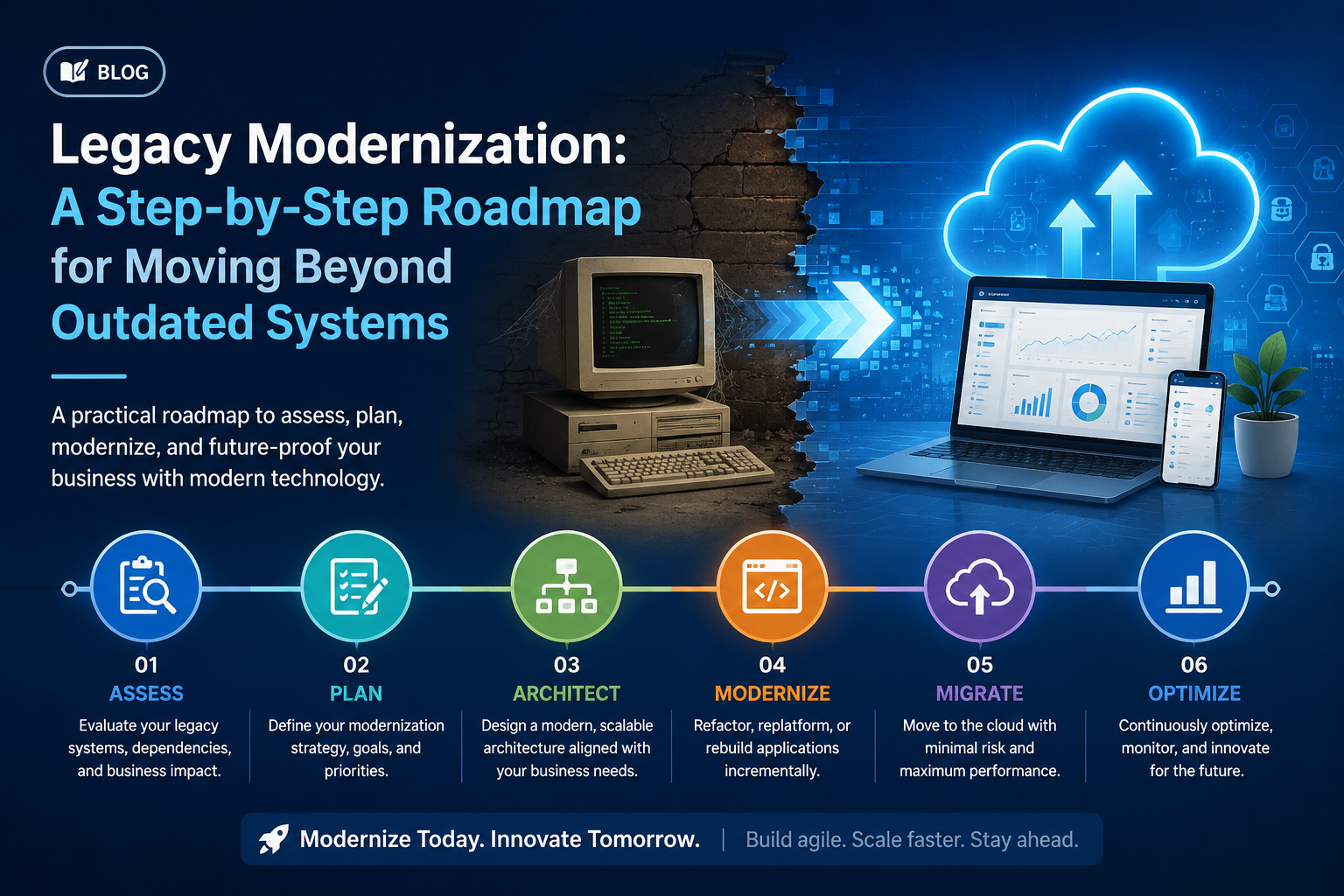
It can be incorporated into broader technology modernization initiatives.
For example, businesses modernizing legacy applications can simultaneously:
- Upgrade outdated cryptographic libraries
- Improve identity management
- Introduce centralized key management
- Modernize APIs
- Strengthen cloud security
- Improve monitoring
- Adopt crypto-agile architectures
This allows organizations to address current technology limitations while preparing for future security requirements.
Best Practices for Post-Quantum Readiness
Businesses can begin preparing by following these practical principles:
- Create a complete cryptographic inventory.
- Identify systems using potentially vulnerable public-key algorithms.
- Prioritize sensitive and long-lived data.
- Monitor evolving PQC standards.
- Design applications for crypto-agility.
- Evaluate third-party vendor readiness.
- Test new cryptographic technologies before deployment.
- Include post-quantum considerations in modernization projects.
- Keep cryptographic libraries and dependencies updated.
- Create a long-term migration roadmap.
Conclusion
Quantum computing represents an important future consideration for enterprise cybersecurity. Businesses do not need to wait for large-scale quantum computers to become operational before taking action.
The most practical approach is to begin with visibility: understand where cryptography is used, identify systems that may require future migration, classify sensitive data, evaluate technology dependencies, and develop a crypto-agile architecture.
Post-quantum cryptography is ultimately about long-term security readiness.
Organizations that begin preparing today can reduce migration risks, protect long-lived information, and create technology environments that are better positioned for the security challenges of tomorrow.
Rio Tech Softwares helps businesses modernize applications and technology environments with solutions aligned with their security, scalability, and digital transformation requirements. Explore Rio Tech Softwares to discover technology solutions designed to support modern and future-ready businesses.