Agentic AI in Sales: How Autonomous AI Agents Transform CRM
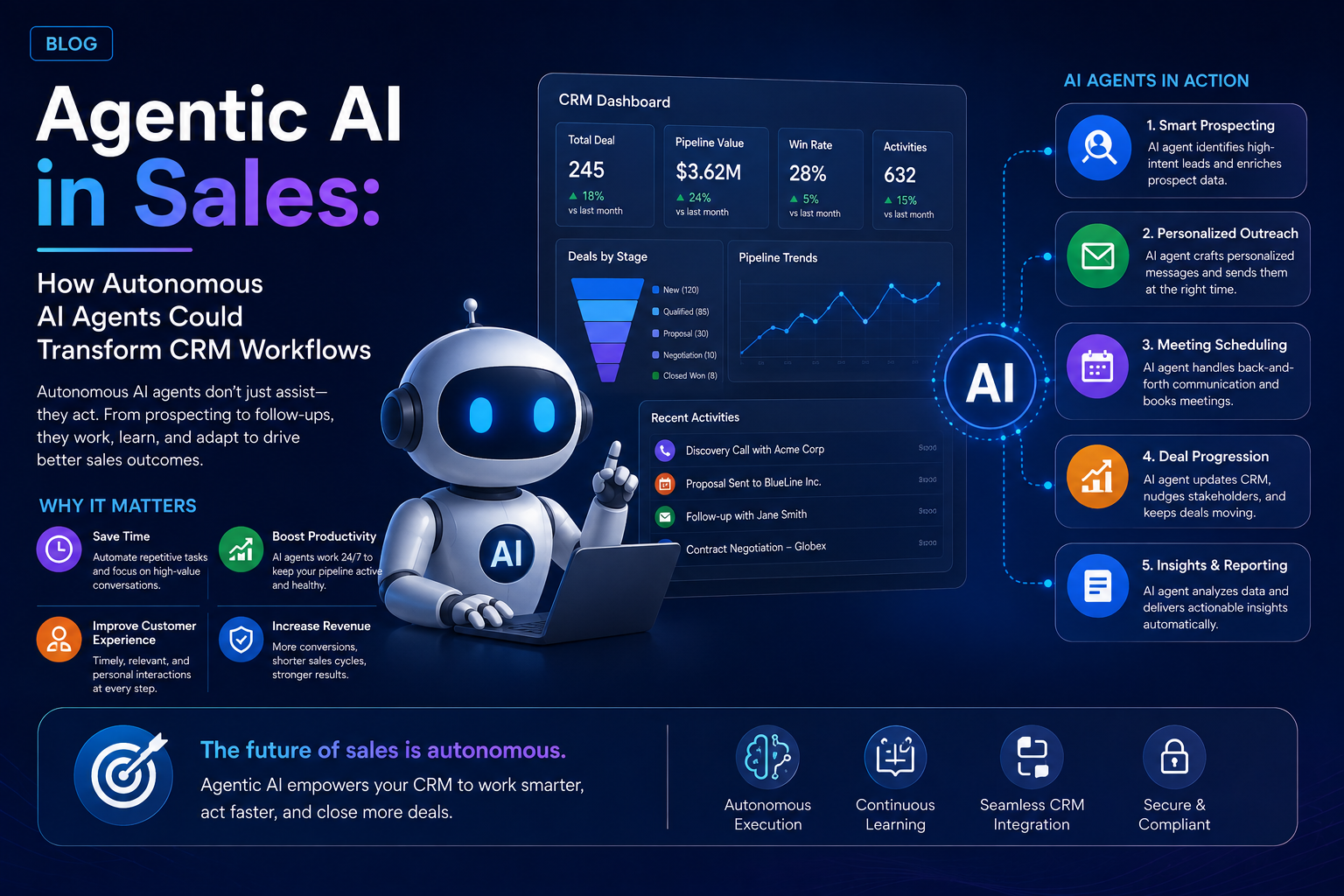
Agentic AI in Sales: How Autonomous AI Agents Could Transform CRM Workflows
Sales teams manage a growing number of activities every day, from identifying prospects and updating CRM records to following up with leads, preparing proposals and maintaining customer relationships.
Traditional CRM systems help organize this information, but many sales workflows still depend heavily on manual actions.
Agentic AI is introducing a new approach to sales automation.
Unlike conventional AI tools that primarily provide recommendations or generate content, autonomous AI agents can be designed to understand objectives, evaluate information, make decisions within defined boundaries and execute multiple steps of a workflow.
This creates an opportunity to transform CRM systems from passive systems of record into more proactive and intelligent platforms.
What Is Agentic AI in Sales?
Agentic AI refers to AI systems capable of working toward a defined goal by planning and carrying out multiple actions with limited human intervention.
In a sales environment, an AI agent could potentially:
- Analyze incoming leads
- Research prospects
- Identify sales opportunities
- Prioritize leads
- Draft personalized communications
- Schedule follow-ups
- Update CRM records
- Trigger workflows
- Monitor customer interactions
- Escalate important opportunities to sales representatives
The goal is not simply to automate one task, but to coordinate multiple activities across a broader sales workflow.
Traditional CRM Automation vs Agentic AI
Traditional CRM automation generally operates through predefined rules.
For example:
If a lead fills out a form → Add lead to CRM → Send email
Agentic AI can introduce a more dynamic workflow:
New lead detected → Analyze lead information → Research account → Assess buying signals → Determine next action → Personalize communication → Update CRM → Schedule follow-up → Escalate when necessary
The key difference is the ability to combine information, reasoning and actions across multiple steps rather than relying exclusively on fixed rules.
How Autonomous AI Agents Could Transform CRM Workflows
1. Intelligent Lead Qualification
AI agents can analyze lead information and relevant customer signals to help determine which prospects deserve immediate attention.
Instead of sales representatives manually reviewing every lead, an agent could prioritize opportunities based on predefined business criteria.
This can help sales teams focus their time on higher-value prospects.
2. Automated Prospect Research
Sales representatives often spend considerable time researching companies before contacting them.
AI agents can assist by gathering relevant information from approved data sources and organizing it into a concise prospect profile.
A CRM record could potentially include:
- Company information
- Industry
- Business size
- Relevant products or services
- Recent activities
- Potential business needs
- Existing interactions
This gives sales teams more context before beginning a conversation.
3. Personalized Customer Outreach
Generic communication is becoming less effective as customers expect more relevant interactions.
AI agents can use available CRM information and customer context to help generate personalized outreach.
For example, instead of sending the same message to every prospect, an AI system could adapt communication based on factors such as industry, previous interactions, customer interests and stage in the sales journey.
Human approval can remain part of the workflow for important communications.
4. Automated Follow-Ups
Missed follow-ups can result in lost opportunities.
An AI agent could monitor CRM activities and determine when a follow-up is due.
A workflow could look like:
Customer Interaction → Follow-Up Requirement Detected → Message Prepared → Approval/Validation → Communication Sent → CRM Updated
This can help sales teams maintain consistent engagement without relying entirely on manual reminders.
5. CRM Data Management
Sales teams often spend time entering and updating CRM information.
Agentic AI can help automate repetitive activities such as:
- Updating customer records
- Recording interaction summaries
- Categorizing leads
- Updating opportunity stages
- Identifying missing information
- Creating activity records
Better CRM data can also improve reporting and sales forecasting.
Agentic AI and Sales Pipeline Management
Managing a sales pipeline requires continuous monitoring.
AI agents could analyze opportunities and identify situations that require attention, such as:
- Deals with no recent activity
- Leads approaching a decision stage
- Opportunities with delayed follow-ups
- Accounts showing increased engagement
- Prospects that may require sales intervention
Instead of sales managers manually reviewing every opportunity, AI could provide proactive alerts and recommended actions.
AI Agents and CRM Integration
Agentic AI becomes more valuable when it can interact with the broader technology environment.
A modern sales ecosystem may include:
CRM + ERP + Marketing Automation + Customer Data + Communication Platforms + AI Agents
For example, an AI agent could receive customer information from a CRM, check relevant business information from an ERP, analyze customer activity and then initiate an appropriate workflow.
APIs and integration platforms can connect these systems while providing controlled access to the data and actions required by AI agents.
The Role of Human Oversight
Autonomous does not necessarily mean completely independent.
For business-critical sales processes, organizations should establish clear boundaries around what AI agents can and cannot do.
For example:
AI can:
- Research prospects
- Analyze customer data
- Recommend actions
- Prepare messages
- Update selected CRM fields
Human approval may be required for:
- High-value proposals
- Contract commitments
- Pricing decisions
- Sensitive customer communications
- Major account decisions
This human-in-the-loop approach can combine AI efficiency with human judgment.
Benefits of Agentic AI in Sales
Increased Sales Productivity
Automating repetitive activities allows sales representatives to spend more time on customer conversations and strategic activities.
Faster Response Times
AI agents can monitor workflows continuously and respond to defined events without waiting for manual intervention.
Better Customer Engagement
AI-driven workflows can use customer context to support more relevant and timely interactions.
Improved CRM Data Quality
Automated updates and structured workflows can reduce the amount of incomplete or outdated information in CRM systems.
Scalable Sales Operations
Organizations can potentially handle larger volumes of leads and customer interactions without increasing manual workload at the same rate.
More Proactive Sales Management
Instead of simply reporting what happened, intelligent systems can identify what may require attention next.
Challenges Businesses Should Consider
Agentic AI also introduces new challenges that businesses need to address.
Data Privacy
AI agents may interact with customer and business information, making appropriate access controls and data governance essential.
System Integration
AI agents need reliable connections to CRM, ERP, communication and other enterprise systems.
Decision Accuracy
AI-generated recommendations should be evaluated carefully, particularly when decisions affect customers, pricing or revenue.
Security
Organizations need to control what AI agents can access and which actions they are permitted to perform.
Governance
Businesses should establish clear policies covering monitoring, approvals, accountability and agent behavior.
Best Practices for Implementing Agentic AI in CRM
Businesses can approach adoption through a structured strategy:
- Identify repetitive CRM workflows
- Select high-value automation opportunities
- Define clear agent responsibilities
- Establish access and security controls
- Integrate trusted business data sources
- Introduce human approval for critical actions
- Test AI agents in controlled environments
- Monitor performance and outcomes
- Measure business impact
- Expand automation gradually
Starting with clearly defined workflows can help organizations understand the practical value of agentic AI before deploying more autonomous processes.
The Future of AI-Powered Sales
The future of CRM is likely to move toward increasingly intelligent and proactive workflows.
Instead of sales representatives manually navigating multiple systems, AI agents could act as intelligent workflow assistants that coordinate information, recommend actions and execute approved tasks across the sales ecosystem.
This could lead to a new generation of CRM platforms where AI is not simply an additional feature but an active layer connecting customer data, business processes and sales operations.
The most successful implementations, however, will likely combine AI autonomy with strong governance, reliable data and human expertise.
Conclusion
Agentic AI has the potential to significantly change how sales teams interact with CRM systems.
By automating lead qualification, prospect research, follow-ups, CRM updates and workflow coordination, autonomous AI agents can reduce repetitive work and allow sales professionals to focus more on relationships, strategy and revenue-generating activities.
However, successful adoption requires more than simply deploying an AI agent. Businesses need secure integrations, quality data, defined workflows, appropriate permissions and human oversight.
As AI technology continues to evolve, Agentic AI in Sales could become an important part of the next generation of CRM automation and digital transformation.
Rio Tech Softwares helps businesses build and modernize intelligent technology environments by combining software development, AI, CRM, cloud and business automation capabilities around their specific operational requirements. Explore RioTech Softwares to discover solutions designed to support scalable, secure and future-ready digital transformation.