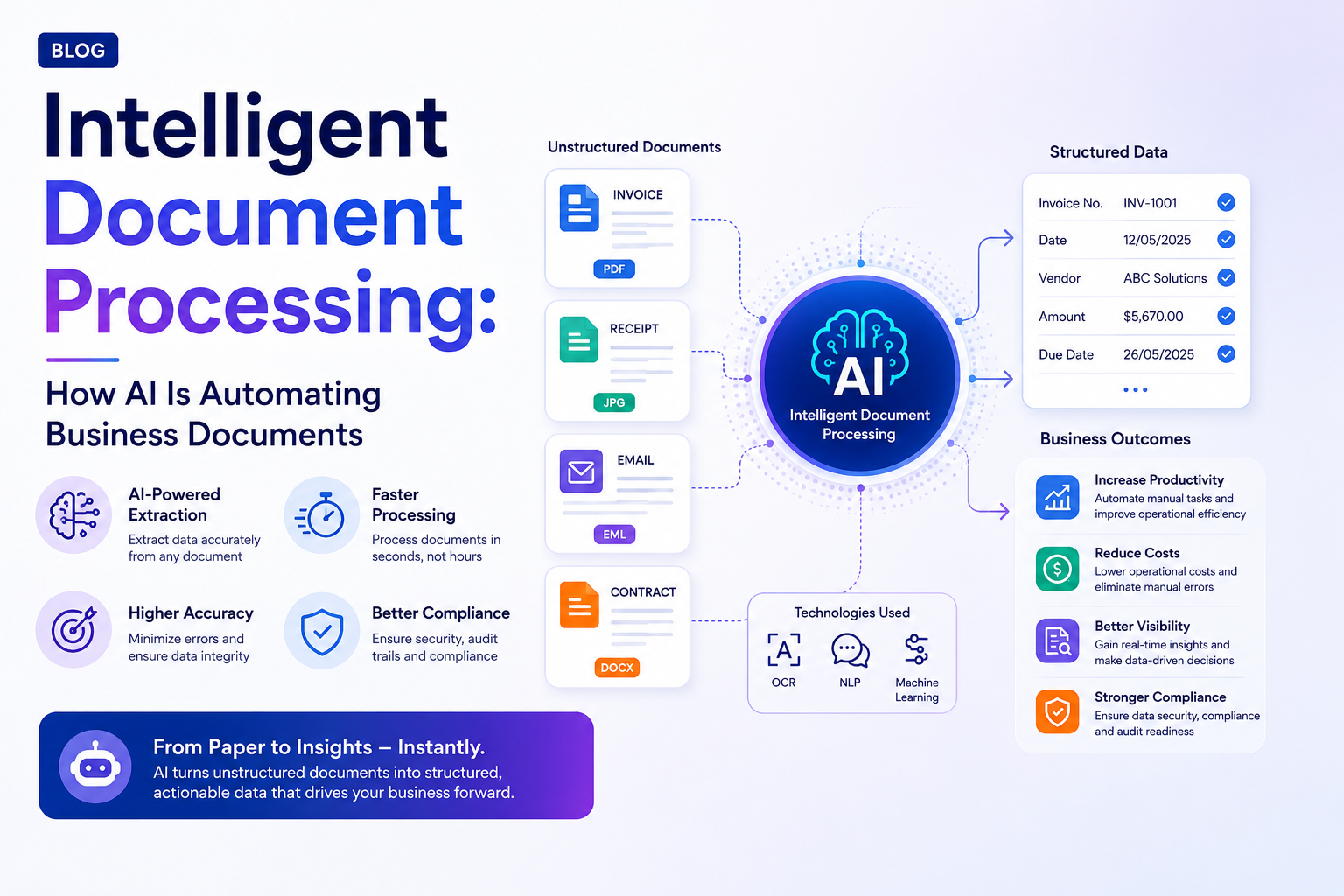
Intelligent Document Processing: How AI Automates Business Documents
Intelligent Document Processing: How AI Is Automating Business Documents
Business documents remain an essential part of everyday operations. Invoices, purchase orders, contracts, application forms, customer records, claims and emails contain valuable information that organizations need to process quickly and accurately.
However, many businesses still depend on manual data entry, document classification, verification and approval processes. As document volumes increase, these activities can consume significant time, increase operational costs and create opportunities for human error.
Intelligent Document Processing (IDP) is changing this approach by combining artificial intelligence, machine learning, optical character recognition (OCR), natural language processing (NLP) and workflow automation to capture and process information from business documents.
Instead of simply converting documents into digital text, modern IDP solutions can identify document types, extract relevant information, validate data and send it into business applications and workflows.
What Is Intelligent Document Processing?
Intelligent Document Processing is an AI-powered approach to automatically capture, classify, extract, validate and process information from documents.
Traditional OCR primarily focuses on recognizing characters from scanned documents. IDP goes further by combining OCR with AI and machine learning to understand document structure and context.
For example, an IDP system can process an invoice and identify:
- Vendor information
- Invoice number
- Date
- Tax details
- Line items
- Total amount
- Payment information
The extracted information can then be validated and transferred to an ERP, accounting system, CRM or another business application.
How AI Is Transforming Document Processing
AI enables document processing systems to move beyond simple text recognition and perform more intelligent tasks.
1. Automatic Document Classification
Businesses receive documents in many formats. AI can identify whether a document is an invoice, contract, purchase order, application, claim or another document type.
This reduces the need for employees to manually sort documents.
2. Intelligent Data Extraction
AI-powered systems can identify important information within documents, including names, dates, amounts, addresses, account numbers and other business fields.
This information can then be converted into structured data for downstream processing.
3. Context Understanding
Modern IDP solutions can analyze document context rather than simply recognizing individual words.
This becomes especially useful when documents have different layouts, formats or structures.
4. Data Validation
Extracted information can be checked against predefined business rules or existing databases.
For example, invoice information can be compared with purchase orders and supplier records before an approval workflow begins.
5. Automated Workflow Processing
Once information has been extracted and validated, it can automatically trigger business processes.
For example:
Invoice Received → Data Extracted → Information Validated → Approval Triggered → ERP Updated → Payment Processed
This reduces repetitive manual intervention and creates faster workflows.
Intelligent Document Processing vs Traditional OCR
Although OCR remains an important component of document automation, IDP provides broader capabilities.
| Traditional OCR | Intelligent Document Processing |
|---|---|
| Converts images into text | Understands and processes document information |
| Primarily text-focused | AI and context-focused |
| Limited classification | Intelligent classification |
| Basic extraction | Advanced data extraction |
| Limited validation | Automated validation |
| Requires more manual processing | Supports end-to-end workflow automation |
| Works best with predictable layouts | Can handle structured, semi-structured and unstructured documents |
Modern IDP combines technologies such as OCR, machine learning, NLP, computer vision and automation to process different types of business documents.
Business Documents That Can Be Automated
Intelligent Document Processing can support a wide range of document-heavy processes.
Common examples include:
- Invoices
- Purchase orders
- Contracts
- Expense reports
- Insurance claims
- Customer applications
- Tax documents
- Employee records
- Bank statements
- Shipping documents
- Forms
- Emails and attachments
- Compliance documents
This makes IDP useful across finance, healthcare, insurance, banking, retail, logistics, manufacturing and professional services.
Key Benefits of Intelligent Document Processing
Reduced Manual Data Entry
Automating repetitive data extraction reduces the amount of information employees need to enter manually.
Improved Operational Efficiency
Documents can move through processing and approval workflows faster, helping organizations reduce bottlenecks.
Better Data Accuracy
Automated extraction and validation can reduce errors associated with repetitive manual data entry.
Faster Decision-Making
When document information becomes structured and accessible, businesses can use it more quickly for reporting, analysis and operational decisions.
Greater Scalability
Organizations can process increasing document volumes without relying entirely on proportional increases in manual effort.
Improved Customer Experience
Faster processing of applications, claims, onboarding documents and other customer records can help organizations respond more efficiently.
How IDP Works With ERP, CRM and Business Applications
The real value of Intelligent Document Processing comes when extracted information is connected to existing business systems.
For example:
Document → IDP → Data Validation → API/Workflow → CRM/ERP → Business Action
An invoice can be processed and automatically transferred to an ERP system.
A customer application can be analyzed and relevant information added to a CRM.
A contract can be classified and routed to the appropriate department for review.
This integration turns document processing from an isolated task into part of a broader digital workflow.
The Role of Generative AI in Document Processing
Generative AI is expanding the capabilities of modern document processing.
Beyond extracting structured fields, AI models can help summarize documents, identify important information and provide higher-level insights from large collections of unstructured content.
For example, businesses may use AI to:
- Summarize lengthy contracts
- Identify important clauses
- Extract key obligations
- Compare documents
- Answer questions about document content
- Detect missing information
- Generate structured summaries
This creates opportunities for businesses to move from basic document automation toward intelligent information management.
Challenges Businesses Should Consider
Despite its benefits, IDP implementation requires careful planning.
Data Quality
Poor-quality scans, handwritten information and inconsistent document formats can affect extraction accuracy.
Integration
IDP solutions need to integrate effectively with ERP, CRM, databases and existing workflows.
Security and Privacy
Business documents can contain confidential financial, customer and employee information. Organizations should implement appropriate access controls, encryption, monitoring and data governance.
Human Oversight
Not every document should be processed without review. Complex or low-confidence cases may require human validation before an automated action is completed.
Process Design
Automating an inefficient process does not automatically make it efficient. Businesses should first understand their existing document workflows and identify the right automation opportunities.
Best Practices for Implementing IDP
Businesses considering Intelligent Document Processing should follow a structured approach:
- Identify document-heavy processes
- Analyze document types and data requirements
- Select suitable AI and OCR capabilities
- Define validation and business rules
- Integrate IDP with existing applications
- Establish security and access controls
- Introduce human review for exceptions
- Test accuracy before full deployment
- Monitor performance continuously
- Expand automation gradually
A phased implementation can help organizations demonstrate value while reducing operational and technical risks.
The Future of Intelligent Document Processing
The future of document automation is moving beyond simple extraction.
AI-powered IDP is increasingly becoming part of broader business automation strategies where documents, applications, workflows and enterprise systems work together.
The combination of AI, generative AI, intelligent automation, APIs, cloud platforms and enterprise applications can help organizations create more connected and efficient digital operations.
Instead of treating documents as static files, businesses can turn them into structured, actionable information that supports automated workflows and better decision-making.
Conclusion
Intelligent Document Processing is transforming how organizations manage document-intensive operations. By combining AI, OCR, machine learning, NLP and automation, businesses can extract valuable information from documents and connect it directly with their operational workflows.
The result can be faster processing, reduced manual effort, improved data quality and more scalable business operations.
As organizations continue their digital transformation journeys, Intelligent Document Processing can become an important component of modern, AI-enabled business infrastructure.
Rio Tech Softwares helps businesses build modern digital solutions across AI, software development, ERP, CRM, cloud and business automation. Explore Rio Tech Softwares RioTech Softwares to discover technology solutions designed to support scalable, secure and future-ready business operations.