Mobile App Development in 2026: What Businesses Should Know
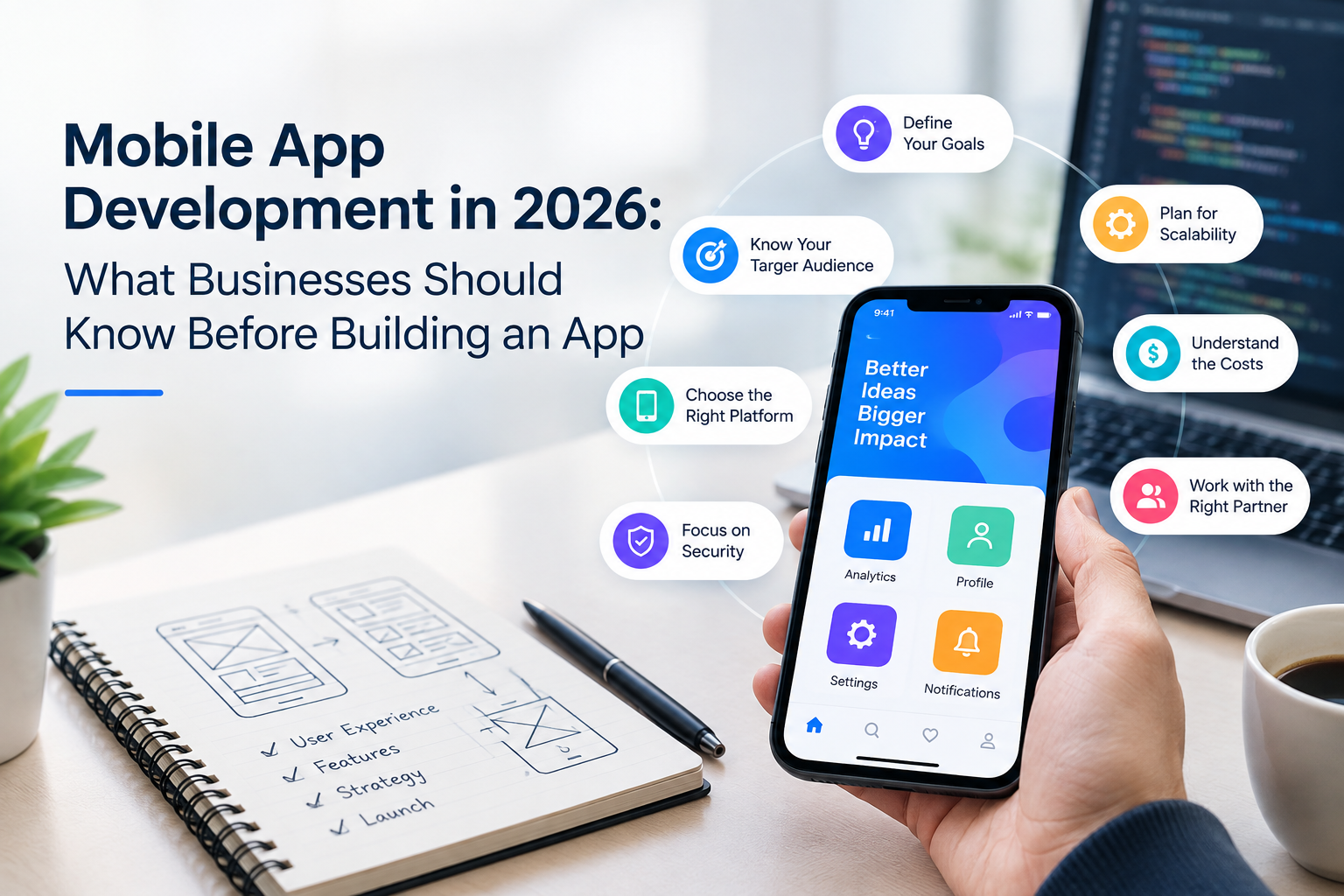
Mobile App Development in 2026: What Businesses Should Know Before Building an App
Mobile applications have become an important part of how businesses engage with customers, deliver services, manage operations, and create digital experiences. In 2026, however, building a successful mobile app requires more than simply developing an Android or iOS application.
Businesses now need to consider artificial intelligence, user experience, security, scalability, cross-platform development, data privacy, and long-term maintenance before starting development. Current industry discussions increasingly highlight AI integration, mature cross-platform technologies, on-device intelligence, and privacy-focused development as important considerations for modern mobile products.
For businesses planning a new application, understanding these factors early can help reduce development risks and create a product that is prepared for future growth.
Why Mobile App Development Matters for Businesses in 2026
Customers increasingly expect businesses to provide convenient, fast, and personalised digital experiences. A well-designed mobile application can provide a direct channel between a business and its customers while also supporting internal processes.
Depending on the business model, an application can help with:
- Customer engagement and communication
- Online purchases and transactions
- Service bookings and appointments
- Customer support
- Loyalty and personalised experiences
- Employee and operational workflows
- Real-time notifications
- Data collection and analytics
- Integration with existing business systems
The objective should not simply be to "have an app." The application should solve a specific business problem and provide measurable value to its users.
1. Start With the Business Problem
One of the most important decisions comes before development begins.
Businesses should clearly define what the application is expected to accomplish. For example, an e-commerce company may need an app to simplify purchasing, while a service company may need an application for bookings, payments, customer communication, and support.
Before development, businesses should identify:
- Target users
- Primary business objectives
- Core features
- Expected user journeys
- Revenue or conversion goals
- Required integrations
- Future expansion plans
A clear product strategy helps prevent unnecessary features from increasing development costs and complexity.
2. Choose Between Native and Cross-Platform Development
Businesses generally have two major development approaches: native development and cross-platform development.
Native applications are developed specifically for platforms such as Android or iOS. They can provide deep access to platform-specific capabilities and are useful when an application requires highly specialised device functionality or performance.
Cross-platform development allows businesses to develop applications for multiple platforms using shared code. Technologies such as Flutter and React Native have become mature options for many business applications.
The right choice depends on:
- Application complexity
- Performance requirements
- Development timeline
- Budget
- Device-specific functionality
- Long-term maintenance requirements
There is no single technology that is appropriate for every application.
3. AI Is Becoming Part of the Mobile Experience
Artificial intelligence is changing both how applications are developed and what applications can do.
Businesses can integrate AI into mobile applications for use cases such as:
- Intelligent search
- Personalised recommendations
- Automated customer support
- Document and content analysis
- Predictive insights
- Smart notifications
- Voice and conversational interfaces
- Workflow automation
Another important development is on-device AI, where certain AI capabilities can run directly on compatible devices. This can be useful for applications where privacy, latency, offline functionality, or operating costs are important considerations.
However, AI should solve a genuine user or business problem rather than being added simply because it is a current technology trend.
4. User Experience Should Be a Priority
A technically advanced application can still struggle if users find it difficult to navigate.
Modern mobile users expect applications to be:
- Fast
- Simple to navigate
- Responsive
- Visually consistent
- Accessible
- Easy to understand
Businesses should map important user journeys before development begins. Registration, login, product discovery, checkout, booking, payment, or customer support should require as few unnecessary steps as possible.
Performance also matters. Slow loading screens, complicated navigation, crashes, and confusing interfaces can negatively affect user engagement.
5. Security and Privacy Must Be Built In
Mobile applications often process sensitive information such as personal details, payment information, business data, location data, and authentication credentials.
Security should therefore be considered from the architecture stage rather than added after development.
Important areas include:
- Secure authentication
- Data encryption
- Secure API communication
- Access controls
- Secure payment integration
- Protection against common application vulnerabilities
- Regular security testing
- Secure data storage
- Privacy-conscious data collection
Privacy-first engineering is increasingly becoming a fundamental part of application planning as businesses operate across different markets and handle growing volumes of user data.
6. Plan for Scalability From the Beginning
An application that works for 1,000 users may require a different architecture when it reaches 100,000 or more users.
Businesses should consider scalability during the initial technical planning process.
This includes:
- Backend architecture
- Database design
- API structure
- Cloud infrastructure
- Caching
- Load management
- Monitoring
- Data storage
- Third-party integrations
Scalable architecture makes it easier to introduce new features and support business growth without rebuilding the entire application.
7. Integrate the App With Existing Business Systems
Many businesses already use CRM, ERP, payment, inventory, accounting, marketing, or customer-support systems.
A new mobile application should ideally work as part of the existing technology ecosystem.
For example, an e-commerce application may need integration with:
Mobile App → API → Product Database → Payment Gateway → Order Management → CRM
Proper integration can reduce manual processes and help businesses maintain consistent information across different platforms.
8. Don't Ignore App Performance
Performance can directly influence the overall user experience.
Businesses should consider:
- Fast application startup
- Optimised images and media
- Efficient API requests
- Offline or low-connectivity support where appropriate
- Memory management
- Battery efficiency
- Crash monitoring
- Backend response times
Performance testing should be conducted across different devices and network conditions rather than relying only on high-end smartphones and fast internet connections.
9. Build an MVP Before Expanding
Businesses do not always need to launch every planned feature in the first version.
A Minimum Viable Product (MVP) can include the most important features required to validate the concept.
For example, an initial e-commerce MVP might include:
- User registration
- Product catalogue
- Product details
- Shopping cart
- Secure payment
- Order tracking
- Customer support
Additional features can then be introduced based on user behaviour and business requirements.
This approach can help businesses test the market while reducing unnecessary initial development complexity.
10. Think About Maintenance Before Launch
Mobile app development does not end when the application is published.
Applications require continuous maintenance because operating systems, devices, security standards, APIs, libraries, and user expectations continue to change.
Ongoing maintenance may include:
- Bug fixing
- Security updates
- OS compatibility updates
- Performance optimisation
- Feature enhancements
- API updates
- Analytics monitoring
- Database maintenance
Businesses should therefore consider long-term maintenance and support when calculating the total cost of developing an application.
11. Select a Development Partner Carefully
Choosing a development partner is an important part of the project.
Businesses should evaluate whether the development team understands:
- Business requirements
- UI/UX design
- Android and iOS development
- Cross-platform technologies
- Backend development
- API integration
- Security
- Testing
- Deployment
- Post-launch maintenance
A development partner should be able to discuss the business objective and technical architecture, not just provide a list of development technologies.
How RIOTECH Approaches Mobile App Development
RIOTECH Softwares provides custom mobile application development for modern businesses, covering Android, iOS, cross-platform applications, Flutter development, and UI/UX design. Its mobile development offering focuses on scalable applications, secure architecture, performance, and user experience.
Businesses looking to explore application development can learn more about RIOTECH's mobile app development services here:
Mobile App Development Services: https://riotechsoftwares.com/mobile.php
Final Thoughts
Mobile app development in 2026 is increasingly focused on creating intelligent, secure, scalable, and user-centred digital products rather than simply putting a business service on a smartphone.
Before starting development, businesses should define their objectives, understand their users, select an appropriate technology strategy, plan for security and scalability, and establish a long-term maintenance roadmap.
The right combination of business strategy, technology, UX, security, and continuous improvement can help transform a mobile application from a simple digital channel into a valuable business platform.
Frequently Asked Questions
1. How much does mobile app development cost in 2026?
The cost depends on application complexity, features, platforms, integrations, UI/UX requirements, backend architecture, security requirements, and ongoing maintenance. A basic MVP and a large enterprise application can have significantly different development requirements.
2. Should a business build an Android and iOS app separately?
Not necessarily. Cross-platform technologies such as Flutter and React Native can allow businesses to develop applications for multiple platforms from a shared codebase. However, native development can still be appropriate for applications requiring specialised platform capabilities.
3. Should businesses add AI to their mobile application?
AI can be valuable when it addresses a genuine business or user requirement. Examples include personalised recommendations, intelligent search, customer support, automation, and data analysis.
4. What should businesses decide before app development begins?
Businesses should define their target audience, objectives, core features, technology approach, integrations, security requirements, budget, timeline, and long-term maintenance strategy.
5. Why is mobile app maintenance important?
Regular maintenance helps applications remain compatible with new operating systems, secure against emerging threats, stable across devices, and aligned with changing business requirements.