AI Workflow Automation: Which Business Processes Should You Automate First?
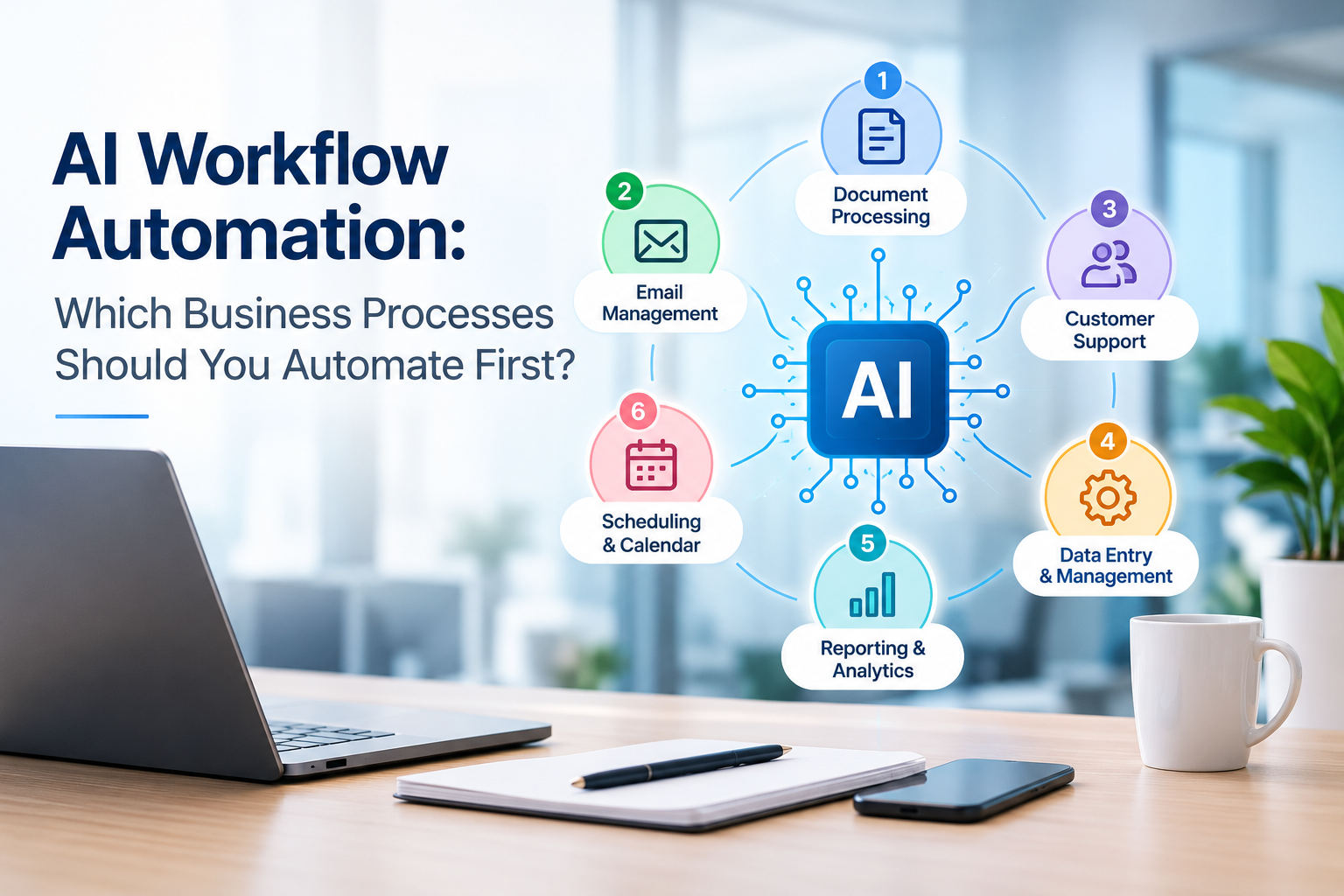
AI Workflow Automation: Which Business Processes Should You Automate First?
Businesses are under constant pressure to improve productivity, reduce operational costs, and deliver faster customer experiences. As companies grow, however, repetitive manual tasks can consume valuable employee time and create unnecessary delays.
AI workflow automation offers a practical way to address these challenges by combining artificial intelligence with business processes. Instead of simply following fixed rules, AI-powered workflows can analyze information, classify requests, generate responses, identify patterns, and support decisions across multiple stages of a process.
However, automation does not mean that every business process should immediately be handed over to AI. The most effective approach is to identify processes where automation can create measurable value while keeping appropriate human oversight for tasks that require judgment or accountability.
What Is AI Workflow Automation?
AI workflow automation uses artificial intelligence to automate or assist with multiple steps within a business process.
Traditional automation generally follows predefined rules. AI workflow automation can work with more variable information, including emails, documents, customer messages, and other unstructured data.
For example, a traditional workflow might automatically send an acknowledgement after a customer submits a form. An AI-powered workflow could go further by understanding the customer's request, categorizing it, extracting important information, assigning a priority, and routing it to the appropriate team.
This makes AI particularly useful for workflows involving large amounts of information, repetitive decisions, and frequent handoffs between teams or systems.
Why Businesses Are Turning to AI Automation
Manual workflows can create bottlenecks as transaction volumes increase. Employees may spend hours entering information, sorting documents, responding to routine questions, preparing reports, or transferring data between different systems.
AI workflow automation can help businesses:
- Reduce repetitive manual work
- Improve workflow consistency
- Speed up routine processes
- Reduce avoidable data-entry errors
- Improve response times
- Organize and analyze business information
- Support employees with faster access to relevant information
- Create scalable processes for business growth
The goal should not simply be to automate as many tasks as possible. Businesses should focus on automating the processes where the combination of frequency, effort, and business impact makes automation worthwhile.
Which Business Processes Should You Automate First?
1. Customer Inquiry and Support Workflows
Customer support is often one of the first areas businesses consider for AI automation because teams receive many repetitive questions.
AI can help categorize incoming queries, identify frequently requested information, provide initial responses, and route complex cases to human representatives.
For example:
Customer message → AI classification → Knowledge lookup → Initial response → Human escalation when required
This approach can help customer-service teams spend more time on complex cases while routine requests are handled more efficiently.
RIOTECH provides AI chatbot and AI automation solutions designed to help businesses improve customer support and automate repetitive interactions.
2. Lead Qualification and Follow-Ups
Sales teams often spend significant time reviewing new leads, entering information into CRM systems, and following up with prospects.
AI automation can assist by:
- Capturing lead information
- Classifying leads based on predefined criteria
- Identifying potential high-priority opportunities
- Updating CRM records
- Drafting personalized follow-up messages
- Creating reminders for sales representatives
Human sales teams can then review important opportunities and make the final decisions.
This creates a workflow where AI handles repetitive preparation while sales professionals remain responsible for relationship-building and important commercial decisions.
3. Invoice and Document Processing
Finance and administration teams frequently work with invoices, purchase orders, receipts, and other business documents.
AI-powered document processing can extract information from documents, classify them, identify missing fields, and route them to the appropriate workflow.
A typical process could look like:
Document received → Information extracted → Data validated → Approval workflow → Accounting system
This can reduce manual data entry and make document processing more consistent.
4. Data Entry and System Updates
Businesses often maintain information across multiple platforms, including CRM, ERP, HR, accounting, and internal systems.
Repeatedly entering the same information into different systems increases administrative workload and creates opportunities for inconsistencies.
AI combined with workflow automation can help identify information, transform it into the required format, and trigger updates between connected systems.
For structured and predictable processes, traditional automation or RPA may be sufficient. AI becomes more useful when the workflow also involves interpreting documents, messages, or other variable information.
5. Employee Onboarding
Employee onboarding includes several repetitive administrative steps, such as collecting documents, creating accounts, sending information, assigning tasks, and notifying relevant departments.
An automated onboarding workflow can coordinate these steps from a central process.
For example:
New employee added → Documents collected → Information verified → Tasks assigned → Notifications sent → Onboarding status tracked
AI can assist with document understanding and employee queries, while predefined automation can manage predictable administrative steps.
6. Reporting and Business Data Analysis
Preparing regular reports can require employees to collect data from different sources, organize it, identify trends, and prepare summaries.
AI-powered analytics can help automate parts of this process by collecting information, identifying patterns, generating summaries, and highlighting unusual changes.
This can help management teams spend less time preparing reports and more time interpreting the information and deciding what actions to take.
RIOTECH's AI Solutions include data analytics and machine learning capabilities that can support data-driven business operations.
7. Marketing Operations
Marketing teams manage numerous repetitive activities, including content workflows, customer segmentation, campaign reporting, lead routing, and performance analysis.
AI can assist with:
- Audience segmentation
- Content classification
- Campaign data analysis
- Lead management
- Report generation
- Customer communication workflows
However, creative strategy, brand positioning, and important marketing decisions should continue to receive human oversight.
8. IT Support and Internal Requests
Internal teams frequently receive requests related to passwords, software access, technical issues, system information, and routine troubleshooting.
An AI-powered internal support workflow can categorize requests, provide relevant information, suggest solutions, and escalate unresolved issues.
This can reduce the workload on IT teams while helping employees receive faster responses.
How to Decide What to Automate First
Not every process is a good candidate for AI automation.
Before automating a workflow, businesses should evaluate several factors.
1. Frequency
How often does the process occur?
A task performed hundreds or thousands of times per month may provide greater automation potential than an occasional task.
2. Time Consumption
How much employee time is spent on the process?
Processes requiring significant repetitive effort can be strong candidates for automation.
3. Business Impact
Does improving the process affect revenue, customer experience, productivity, or operational efficiency?
A high-volume process with meaningful business impact deserves closer evaluation.
4. Process Stability
Is the workflow reasonably well-defined?
If a process constantly changes or has unclear ownership, redesigning the workflow may need to happen before automation.
5. Exception Rate
How frequently does the process require human intervention?
Processes with predictable outcomes and manageable exceptions are generally easier to automate.
6. Data Availability
Does the business have access to the information required for automation?
AI systems need reliable and appropriately governed data to produce useful results.
7. Risk and Compliance
Some processes involve sensitive information, financial decisions, legal obligations, or other high-impact decisions.
These workflows may require stronger controls and human approval rather than complete automation.
Automation vs. Human Decision-Making
One of the most important considerations is understanding where AI should act independently and where humans should remain involved.
A useful model is:
Automate → Assist → Escalate
Automate
Use automation for repetitive, predictable, low-risk tasks.
Assist
Use AI to provide recommendations, summaries, classifications, or drafts while employees review the output.
Escalate
Send complex, sensitive, or high-risk cases to the appropriate human decision-maker.
This approach allows organizations to benefit from AI without treating automation as a replacement for human judgment. Harvard Business School's discussion of AI-powered process automation similarly distinguishes between automation and augmentation, particularly for workflows involving higher-value decisions.
A Practical AI Automation Roadmap
Businesses do not need to automate their entire operation at once.
A practical implementation approach is:
Step 1: Map the workflow
Document how the process currently works, including inputs, approvals, systems, people, and outputs.
Step 2: Identify repetitive activities
Look for tasks that consume significant time without requiring complex human judgment.
Step 3: Establish a baseline
Measure current processing time, error rates, workload, response time, or other relevant metrics.
Step 4: Select a focused pilot
Start with one well-defined process instead of attempting a company-wide transformation immediately.
Step 5: Integrate AI with existing systems
Connect the automation workflow with relevant CRM, ERP, databases, communication platforms, or internal applications.
Step 6: Add human checkpoints
Define where employees should review, approve, or override AI-generated outputs.
Step 7: Measure performance
Compare the automated workflow against the original baseline.
Step 8: Scale gradually
Once the workflow demonstrates reliable results, expand automation to additional processes.
This gradual approach helps businesses identify technical, operational, and governance issues before expanding automation across larger parts of the organization.
The Role of AI in Modern Business Operations
AI workflow automation is becoming an important part of digital transformation because it can connect intelligent decision-making with everyday business processes.
The real value, however, does not come from simply adding AI to an existing workflow. Businesses need to identify the right process, define measurable objectives, establish appropriate controls, and integrate AI into the broader technology environment.
For companies looking to explore AI automation, machine learning, chatbots, and data-driven solutions, RIOTECH Softwares AI Solutions provides AI-focused technology services designed to help businesses automate operations, improve customer experiences, and support data-driven decision-making.
Conclusion
The best place to start with AI workflow automation is not necessarily the most complicated business process. It is often a repetitive, high-volume workflow where automation can produce measurable improvements without introducing unnecessary risk.
Customer support, lead management, document processing, data entry, employee onboarding, reporting, marketing operations, and internal IT requests can all provide opportunities for AI-assisted automation.
The key is to start with one process, measure the results, maintain appropriate human oversight, and scale based on evidence.
When implemented strategically, AI workflow automation can become more than a productivity tool. It can form part of a scalable digital infrastructure that helps businesses operate faster, manage information more effectively, and focus human expertise where it creates the greatest value.