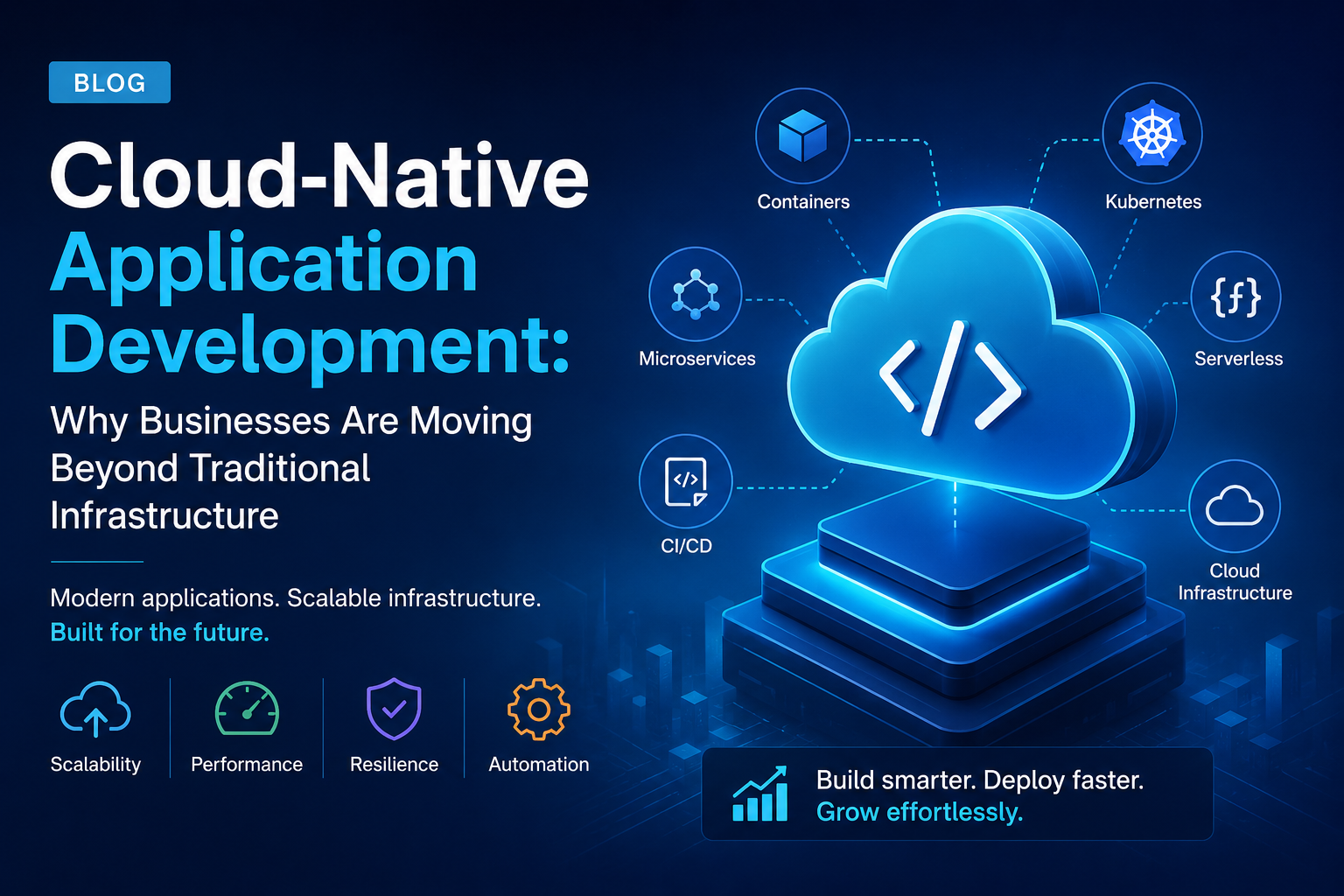
Cloud-Native Application Development: Why Businesses Are Moving Beyond Traditional Infrastructure
Cloud-Native Application Development: Why Businesses Are Moving Beyond Traditional Infrastructure
Cloud technology has fundamentally changed how businesses build, deploy, and manage software. As organizations demand faster releases, greater scalability, improved reliability, and more efficient infrastructure, traditional application environments are increasingly becoming difficult to maintain.
Cloud-native application development offers a modern approach that enables businesses to build applications specifically for dynamic cloud environments. Instead of simply moving existing applications to the cloud, organizations are redesigning how applications are developed, deployed, scaled, and managed.
What Is Cloud-Native Application Development?
Cloud-native application development is an approach to building and operating applications that takes full advantage of cloud computing capabilities.
Cloud-native applications commonly use technologies and practices such as:
- Microservices architecture
- Containers
- Kubernetes and container orchestration
- Serverless computing
- APIs and distributed services
- Infrastructure as Code
- Continuous Integration and Continuous Deployment (CI/CD)
- Automated monitoring and observability
The goal is not simply to host an application in the cloud. Instead, cloud-native development focuses on creating applications that are scalable, resilient, flexible, and easier to continuously improve.
Why Traditional Infrastructure Is Becoming a Challenge
Traditional infrastructure often depends on physical servers, fixed capacity, manual configuration, and tightly connected application components.
While this approach can work for stable workloads, it can become challenging when businesses need to:
- Scale applications quickly
- Release new features frequently
- Support rapidly changing customer demand
- Operate applications across multiple environments
- Reduce infrastructure management overhead
- Improve application availability
- Respond quickly to market changes
For growing digital businesses, infrastructure must be able to adapt as quickly as the applications running on it.
Key Benefits of Cloud-Native Development
1. Greater Scalability
One of the biggest advantages of cloud-native applications is the ability to scale resources according to demand.
Businesses can increase computing resources when traffic rises and reduce them when demand decreases. This dynamic approach can be particularly valuable for applications experiencing unpredictable or seasonal workloads.
2. Faster Application Development
Cloud-native development supports modern development practices such as automation, CI/CD, and modular architectures.
Development teams can work on individual services and release changes more frequently instead of waiting for large application-wide releases.
This can help businesses bring new features and improvements to customers faster.
3. Improved Application Resilience
Cloud-native architectures can be designed so that the failure of one component does not necessarily bring down the entire application.
For example, a microservices-based application can isolate certain services and allow other parts of the system to continue operating.
This can improve application resilience and reduce the impact of individual failures.
4. Better Resource Utilization
Traditional infrastructure may require businesses to maintain enough hardware capacity to handle peak workloads.
Cloud-native environments provide more flexible resource allocation. Businesses can provision and scale resources based on actual requirements, potentially improving infrastructure efficiency.
5. Easier Continuous Delivery
Cloud-native development works well with automated CI/CD pipelines.
Developers can automatically build, test, and deploy application updates through controlled workflows.
This reduces reliance on manual deployment processes and helps create a more consistent software delivery lifecycle.
6. Greater Development Flexibility
Cloud-native architectures allow teams to use different technologies and services where appropriate.
With modular architectures such as microservices, teams can update or replace individual components without necessarily redesigning the entire application.
This flexibility can support long-term modernization strategies.
Core Technologies Behind Cloud-Native Applications
Microservices
Microservices divide an application into smaller, independently manageable services.
Each service can focus on a specific business capability and communicate with other services through APIs.
This can make large applications easier to develop, deploy, and maintain.
Containers
Containers package applications together with their dependencies so they can run consistently across different environments.
This helps reduce differences between development, testing, and production environments.
Kubernetes
Kubernetes is widely used to orchestrate containerized applications.
It can help automate tasks such as deployment, scaling, service discovery, and workload management.
Serverless Computing
Serverless technologies allow developers to run application functionality without directly managing the underlying server infrastructure.
Businesses can use serverless architectures for suitable workloads while allowing cloud providers to handle much of the infrastructure management.
Infrastructure as Code
Infrastructure as Code allows infrastructure configurations to be defined and managed through code.
This can improve consistency, automation, repeatability, and version control across environments.
Cloud-Native vs. Traditional Application Development
| Traditional Infrastructure | Cloud-Native Approach |
|---|---|
| Fixed infrastructure capacity | Dynamic resource scaling |
| Often manual deployment | Automated CI/CD |
| Monolithic architectures are common | Microservices and modular architectures |
| Hardware-focused management | Software-defined infrastructure |
| Slower infrastructure changes | Faster automated provisioning |
| Scaling can require significant planning | Automated or flexible scaling |
| Releases may be less frequent | Continuous delivery is encouraged |
The transition to cloud-native does not mean that every traditional application must immediately be replaced. Businesses can gradually modernize applications based on technical and business priorities.
Challenges Businesses Should Consider
Cloud-native development provides significant advantages, but it also introduces complexity.
Increased Architectural Complexity
Distributed applications can be more difficult to design, monitor, and troubleshoot than traditional monolithic applications.
Security Requirements
Cloud-native environments can involve containers, APIs, cloud services, identities, and distributed infrastructure. Businesses need strong security controls across the entire environment.
Skills and Training
Development and operations teams may need experience with cloud platforms, containers, Kubernetes, automation, DevOps, observability, and distributed systems.
Cost Management
Cloud resources are flexible, but poor resource management can result in unexpected costs. Organizations need monitoring, budgeting, and optimization practices.
Migration Complexity
Moving an existing traditional application to a cloud-native architecture can require significant planning. Businesses must determine which components should be migrated, modernized, replaced, or retained.
How Businesses Can Begin Their Cloud-Native Journey
Organizations do not need to transform their entire infrastructure at once.
A practical approach is to begin with a focused modernization strategy.
Step 1: Assess Existing Applications
Identify applications that would benefit most from improved scalability, availability, deployment speed, or infrastructure flexibility.
Step 2: Define Business Objectives
Determine what the organization wants to achieve, such as faster releases, improved reliability, reduced operational overhead, or better scalability.
Step 3: Select the Right Cloud Architecture
Evaluate whether containers, microservices, serverless technologies, managed cloud services, or a combination of approaches is appropriate.
Step 4: Automate Development and Deployment
Introduce CI/CD pipelines, automated testing, Infrastructure as Code, and deployment automation where appropriate.
Step 5: Strengthen Monitoring and Security
Implement observability, logging, monitoring, identity management, security testing, and appropriate governance processes.
Step 6: Start With a Pilot
Modernize a suitable application or business capability first. Measure the results before expanding the approach across the organization.
The Future of Cloud-Native Application Development
Cloud-native development is becoming an important foundation for modern digital businesses.
As organizations adopt AI, real-time applications, APIs, data-intensive platforms, and increasingly distributed systems, the ability to scale infrastructure and deploy software quickly becomes more important.
Cloud-native architectures can provide the flexibility needed to support these evolving requirements.
However, successful cloud adoption is not simply about choosing a cloud provider. Businesses need the right architecture, development practices, security strategy, automation, and operational processes.
How Riotech Can Help
For businesses planning application modernization or cloud transformation, selecting the right technology strategy is critical.
Riotech helps businesses explore modern application development and cloud-native solutions designed around their operational requirements, scalability goals, and digital transformation objectives.
From application modernization and cloud-native development to DevOps, automation, and ongoing technical support, a well-planned technology strategy can help organizations build applications that are more scalable, resilient, and ready for future growth.
Conclusion
Cloud-native application development represents a major shift from traditional infrastructure and application delivery.
By using technologies such as containers, microservices, Kubernetes, serverless computing, Infrastructure as Code, and CI/CD, businesses can build software environments that are more adaptable to changing requirements.
The transition requires careful planning, investment in skills, strong security practices, and effective cost management. But for organizations seeking faster development, greater scalability, improved resilience, and continuous innovation, cloud-native development can provide a strong foundation for the future.
The future of application development is not simply about moving to the cloud. It is about building applications that are designed to take full advantage of what the cloud can offer.
Recent Posts
21 Aug 2026