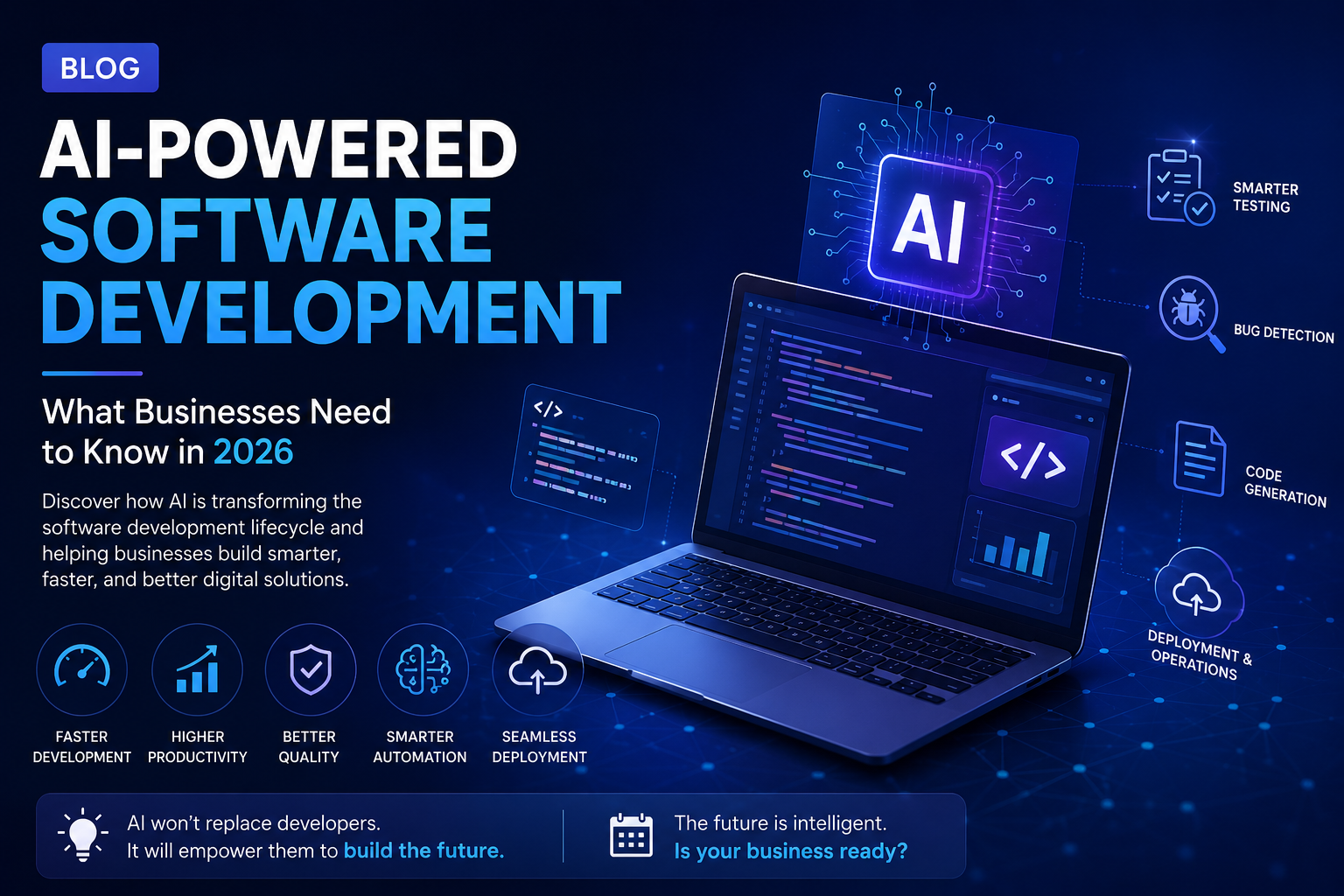
AI-Powered Software Development
AI-Powered Software Development: What Businesses Need to Know in 2026
Artificial intelligence is transforming the way software is planned, developed, tested, deployed, and maintained. In 2026, AI-powered software development is no longer limited to experimental projects or developer productivity tools. Businesses across industries are increasingly using AI to accelerate development, improve software quality, automate repetitive engineering tasks, and build smarter digital products.
For organizations planning a new software platform or modernizing an existing application, understanding how AI is changing software development can help them make better technology and investment decisions.
What Is AI-Powered Software Development?
AI-powered software development refers to the use of artificial intelligence and machine learning technologies throughout the software development lifecycle.
AI can assist development teams with activities such as:
- Generating and improving source code
- Understanding existing codebases
- Creating technical documentation
- Detecting bugs and vulnerabilities
- Generating and executing software tests
- Analyzing application performance
- Automating repetitive development tasks
- Supporting DevOps and deployment workflows
- Building intelligent features into applications
Rather than replacing developers, AI is becoming a development partner that helps teams work faster while allowing engineers to focus more on architecture, problem-solving, innovation, and business requirements.
Why AI-Powered Development Matters in 2026
Businesses are under increasing pressure to launch digital products faster while maintaining security, reliability, scalability, and cost efficiency.
Traditional software development can require significant time for coding, testing, documentation, debugging, and maintenance. AI can automate or accelerate many of these activities.
1. Faster Software Development
AI coding assistants can help developers generate code, suggest implementations, explain existing functions, and identify potential issues.
This can reduce the time required for repetitive programming tasks and help development teams move from concept to working software more efficiently.
However, AI-generated code still requires human review, testing, and validation before being used in production.
2. Improved Developer Productivity
Developers often spend considerable time on repetitive activities such as writing boilerplate code, creating test cases, reviewing code, and documenting applications.
AI can assist with these processes, allowing developers to dedicate more time to complex technical decisions and product innovation.
3. Smarter Software Testing
Testing is one of the most important stages of software development.
AI can help teams generate test cases, identify unusual application behavior, analyze errors, and prioritize areas that require additional testing.
This can contribute to faster quality assurance while helping development teams identify problems earlier in the development lifecycle.
4. Better Code Maintenance
Maintaining legacy applications can be challenging because developers may need to understand large and outdated codebases.
AI tools can analyze existing code, explain complex functions, identify dependencies, and assist developers in modernizing older applications.
This can make application modernization more manageable for businesses that rely on legacy systems.
5. Faster Problem Resolution
AI can analyze error messages, logs, code patterns, and application behavior to help developers identify possible causes of technical problems.
Instead of manually searching through large amounts of information, developers can use AI assistance to narrow down potential solutions and investigate issues more efficiently.
AI Is Also Changing the Software Development Lifecycle
The impact of AI extends beyond writing code.
Planning and Requirements
AI can help analyze business requirements, identify missing information, summarize stakeholder discussions, and convert high-level requirements into technical tasks.
Design and Architecture
AI can assist teams in exploring architecture options, identifying potential technical risks, and evaluating different approaches to application development.
Human architects and developers remain essential for making final architectural decisions based on security, scalability, business requirements, and long-term maintainability.
Development
During development, AI can support code generation, debugging, refactoring, documentation, and code explanation.
Testing
AI can assist with automated test generation, test analysis, regression testing, and defect identification.
Deployment and Operations
AI can support monitoring, log analysis, anomaly detection, incident investigation, and operational automation.
This creates a more connected and intelligent software development lifecycle.
Key Benefits for Businesses
When implemented correctly, AI-powered development can provide several business advantages.
Reduced Development Time: Automating repetitive engineering activities can help teams deliver projects more efficiently.
Lower Development Costs: Improved developer productivity can reduce the amount of time required for certain development and maintenance tasks.
Faster Innovation: Businesses can experiment with new features and digital solutions more quickly.
Improved Software Quality: AI-assisted testing and code analysis can help identify potential issues earlier.
Better Scalability: AI can support development teams as application complexity and business requirements grow.
Improved Developer Experience: Developers can spend less time on repetitive tasks and more time solving meaningful technical problems.
Challenges Businesses Should Consider
AI-powered development also introduces new risks and challenges.
Security Risks
AI-generated code may contain vulnerabilities or insecure implementation patterns. Businesses should maintain strong code-review, security-testing, and compliance processes.
Data Privacy
Organizations must carefully evaluate what proprietary, customer, or confidential information is shared with AI development tools.
Code Quality
AI can generate technically valid code that may still be inefficient, difficult to maintain, or unsuitable for a specific application architecture.
Overdependence on AI
AI should support engineering teams rather than replace technical judgment. Developers need to understand, review, test, and validate AI-generated output.
Governance and Compliance
Businesses should establish clear policies around approved AI tools, data usage, intellectual property, security, code review, and human oversight.
How Businesses Can Adopt AI-Powered Development
Organizations do not need to transform their entire software development process overnight.
A practical approach is to start with controlled use cases.
Step 1: Identify Repetitive Tasks
Determine which development activities consume significant time, such as documentation, test generation, code explanation, or routine coding.
Step 2: Select Appropriate AI Tools
Choose AI solutions based on security requirements, development environment, integration capabilities, and business needs.
Step 3: Establish Human Oversight
Create clear review processes for AI-generated code, documentation, tests, and technical recommendations.
Step 4: Start With a Pilot Project
Test AI-assisted development on a limited project before introducing it across the organization.
Step 5: Measure Results
Track development speed, software quality, defect rates, developer productivity, and operational impact.
Step 6: Build AI Governance
Define guidelines for security, privacy, data handling, intellectual property, and responsible AI usage.
The Future of AI-Powered Software Development
The future of software engineering is likely to become increasingly collaborative, with developers working alongside intelligent AI systems.
AI agents are expected to take on more development-related tasks, from analyzing requirements and creating implementation plans to generating code, running tests, identifying problems, and assisting with deployment workflows.
However, successful software will still require human expertise.
Business understanding, system architecture, security decisions, user experience, strategic thinking, and accountability cannot simply be delegated to an AI system.
The organizations that benefit most will be those that combine AI-driven productivity with strong engineering practices and human expertise.
How Riotech Can Help
For businesses looking to modernize applications, develop new software, or introduce AI into their technology environment, choosing the right development approach is critical.
Riotech helps businesses explore modern software development solutions designed around their operational requirements, scalability goals, and digital transformation needs.
From software development and application modernization to AI-driven solutions and ongoing technical support, the right technology strategy can help organizations build systems that are more efficient, scalable, and ready for the future.
Conclusion
AI-powered software development is becoming an important part of modern business technology in 2026. It can accelerate development, improve productivity, strengthen testing, simplify maintenance, and help organizations innovate faster.
But AI is not a substitute for experienced software engineering.
The strongest approach is a balanced one: use AI to accelerate development while relying on human expertise for architecture, security, quality, and strategic decision-making.
For businesses preparing their next digital transformation initiative, adopting AI-powered development today can create a stronger foundation for tomorrow's technology landscape.
Frequently Asked Questions
What is AI-powered software development?
AI-powered software development uses artificial intelligence to assist with coding, testing, debugging, documentation, maintenance, and other software engineering activities.
Can AI replace software developers?
AI can automate many repetitive development tasks, but human developers remain essential for architecture, problem-solving, security, business understanding, and quality assurance.
Is AI-generated code safe to use?
AI-generated code should always be reviewed, tested, and assessed for security and quality before being deployed to production.
How can a business start using AI in software development?
Businesses can begin with controlled use cases such as code assistance, automated testing, documentation, debugging, or legacy-code analysis, followed by a structured pilot and governance process.
Why should businesses consider AI-powered development in 2026?
It can help organizations improve development efficiency, accelerate innovation, reduce repetitive work, and build more adaptable digital solutions.
Build smarter. Develop faster. Innovate with confidence.
Recent Posts
21 Aug 2026